All published articles of this journal are available on ScienceDirect.

Zinc and IL-6: Biomarkers of Neonatal Sepsis Risk and Immune Response in Newborns
 Adelia Anggraini Utama1
Iskandar2
Pudji Andayani1
Alfi Yasmina1
Selli Muljanto1
Edi Hartoyo1
Ari Yunanto1
Eko Suhartono3
Julia Kasab1
Adelia Anggraini Utama1
Iskandar2
Pudji Andayani1
Alfi Yasmina1
Selli Muljanto1
Edi Hartoyo1
Ari Yunanto1
Eko Suhartono3
Julia Kasab1
Authors Info & Affiliations
Abstract
Introduction
Neonatal sepsis is one of the major causes of morbidity and mortality in newborns, particularly in developing countries. Zinc levels are involved in the outcome of sepsis, as they influence the function of the immune system and cytokine activity such as Interleukin-6 (IL-6). Data regarding the association between zinc and neonatal sepsis remain limited.
Methods
This observational, analytical, cross-sectional study investigated the correlation between zinc and IL-6 in neonates with neonatal sepsis. Participants were divided into a control group and a sepsis-risk group. Serum samples were analyzed for zinc by titration and for IL-6 by enzyme immunoassay.
Results
A total of 69 neonates were recruited and were divided into a control group of 34 neonates and a group at risk of sepsis of 35 neonates. Zinc levels in the sepsis-risk group were significantly lower than in the control group (57.34 ± 8.89 µg/dL vs. 80.47 ± 13.80 µg/dL, p<0.001). There was no significant difference in IL-6 levels between the two groups. A significant negative correlation was observed between serum zinc levels and the risk of sepsis (correlation coefficient = -0.548, P < 0.05).
Discussion
This study demonstrates that lower serum zinc levels are associated with a higher prevalence of sepsis risk in neonates, suggesting that susceptibility to sepsis in the early neonatal period may be associated with zinc status. The absence of a significant difference in IL-6 levels between groups may have been influenced by the timing of sample collection, as subjects were identified based on sepsis risk factors rather than confirmed infection.
Conclusion
Neonates at risk for sepsis had lower serum levels of zinc but not the level of IL-6 when compared with healthy neonates. These study findings support a relationship between the neonate's zinc status and its early immune status. Further research is required to establish its effectiveness in a clinical setting.
1. INTRODUCTION
Neonatal sepsis remains a serious health issue, causing morbidity and mortality, particularly in developing countries. The global trend shows a gradual reduction over the past three decades, but the situation remains serious in Africa and Southeast Asia [1]. Data from an observational study in Indonesia show incidence rates ranging from 9 to 30% with a mortality rate of 12 to 50% [2]. According to our regional hospital, Ulin Hospital, 123 cases of neonatal sepsis were recorded in 2013 [3].
Neonatal sepsis is the third most important cause of neonatal death worldwide [4]. The mortality caused by neonatal sepsis in 2019 has been estimated to be 226,520 deaths with an Age-Standardized Death Rate (ASDR) of 2.5 per 100,000 population [5]. Neonatal mortality is an indicator of population growth and public health conditions. Reducing neonatal mortality has been set as one of the targets of Sustainable Development Goals (SDGs) with a target of 12/1,000 live births by 2030 [6].
There are many micronutrient deficiencies, including iron, copper, vitamin A, zinc, and other minerals may increase susceptibility to sepsis [7]. Previous research has shown that zinc levels are associated with the prognosis of neonatal sepsis; lower zinc levels are associated with poor clinical outcomes [8]. Zinc is an essential micronutrient with a key role in numerous body functions, including the immune system [9]. Zinc plays important anti-inflammatory and immunomodulatory roles in the body, largely by inhibiting the Nuclear Factor Kappa B (NF-κB) signaling pathway. This pathway regulates key cellular processes, including apoptosis, cell proliferation, and immune function. Moreover, zinc can suppress interleukin-6 (IL-6) mediated activation of signal transducer and activator of transcription 3 (STAT3) and contribute to immune homeostasis [10]. Zinc deficiency can impair thymic function and T cell maturation by reducing thymulin and antiapoptotic protein (B-cell lymphoma 2 (BCL-2) and B-cell lymphoma X (BCL-X)) activity and increasing apoptosis in developing T cells [11]. This cytokine imbalance suppresses T-helper 1 (Th1) responses (IL-2, Interferon Gamma (IFN-γ)) while retaining T-helper 2 (Th2) cytokines, IL-4, IL-6, and IL-10, which may reduce the neonate’s capacity to mount an effective immune response [12, 13].
Pleiotropic cytokines such as IL-6 play an important role in the acute phase response, inflammation, and immune cell differentiation [14]. In response to infection, IL-6 is produced by a variety of maternal and fetal tissues including mononuclear cells, trophoblasts, and fetal membranes [15]. This cytokine has been identified in several studies as a sensitive and specific early indicator of neonatal sepsis, often elevated before C-Reactive Protein (CRP) levels [16, 17]. Furthermore, IL-6 regulates systemic zinc levels by enhancing hepatocyte Zrt- and Irt-like Protein 14 (ZIP14) expression, thereby reducing serum zinc levels during inflammation [14, 18]. This adaptive response limits the availability of zinc to pathogens, thereby limiting zinc availability to pathogens during infection. In neonates with immature immune systems, long-lasting elevations in IL-6 intensify systemic inflammation and tissue injury, and may even cause organ dysfunction [19, 20]. Several studies have shown a relationship between elevated IL-6 levels and disease severity and mortality risk in neonatal sepsis and Systemic Inflammatory Response Syndrome (SIRS) [21, 22].
Despite growing global evidence, no study has evaluated the comparative zinc and IL-6 levels in healthy and sepsis-risk neonates in Banjarmasin. Investigating the relationship between these markers in the early phase of infection may provide insights into potential preventive or diagnostic strategies. Therefore, this study aims to compare serum zinc and IL-6 levels in neonates at risk for sepsis and healthy controls, and to assess the correlation between zinc and IL-6 levels in the sepsis-risk group.
2. METHODS
2.1. Research Design
This was an observational analytic cross-sectional study conducted among 69 neonates born between October 2020 and July 2021 at Ulin General Hospital, Banjarmasin, South Kalimantan, Indonesia. Inclusion criteria were live-born neonates within the study period. Exclusion criteria were neonates with a birth weight of less than 2000 grams, a gestational age of less than 32 weeks, major congenital anomalies, or incomplete clinical or laboratory data. Neonates were divided into two groups: a control group (n = 34) and a sepsis-risk group (n = 35). The control group consisted of neonates without clinical or maternal risk factors for sepsis, including absence of prolonged rupture of membranes, maternal fever, chorioamnionitis, or prematurity. These neonates had normal birth weight (>2000 g), gestational age ≥32 weeks, and no congenital anomalies. The sepsis-risk group consisted of neonates identified to have risk factors for sepsis based on the American College of Obstetricians and Gynecologists (ACOG) guidelines, particularly Premature Rupture of Membranes (PROM) for more than 18 hours [23]. The study was conducted prospectively, with blood samples obtained from the umbilical cord immediately after birth.
Sample size determination was conducted using the standard formula for cross-sectional studies: n = Z2 × p × (1 − p) / d2, where Z = 1.96 (for α = 0.05), p = 0.08 (estimated proportion of neonatal sepsis), and d = 0.10 (absolute precision). This yielded a minimum of 28 neonates per group. To minimize bias, this study performs total-population sampling method. The final number of participants is 69 subjects.
2.2. Serum Zinc Level Analysis
Serum zinc concentration was measured by complexometric titration using Ethylenediaminetetraacetic Acid (EDTA). Because serum zinc is highly susceptible to pre-analytical contamination and hemolysis, only non-hemolyzed serum samples were included, and trace-element clean tubes, glassware, and reagents were used throughout the procedure. Analytical-grade reagents were obtained from Merck® (Darmstadt, Germany) [24, 25].
An aliquot of 1 mL serum was diluted with distilled water to a final volume of 250 mL. Subsequently, 25 mL of the diluted solution was transferred into an Erlenmeyer flask and mixed with 15 mL distilled water, 10 mL ammonia buffer solution (pH 10), and 3 drops of Eriochrome Black T (EBT) indicator. The mixture was titrated with standardized 0.01 M EDTA solution until the endpoint color changed from wine red to blue. Zinc concentration was calculated from the volume of EDTA consumed using the equation: Zn (mg/L) = V_EDTA × M_EDTA × 65.38, where V_EDTA is the volume of EDTA used (L), M_EDTA is the molarity of EDTA (mol/L), and 65.38 is the atomic weight of zinc. Calibration was performed using zinc sulfate standards in the range of 0.1–1.0 mg/L. The use of ammonia buffer at pH 10, EDTA as the chelating titrant, and EBT as the indicator is in line with the standard complexometric titration principle for zinc determination [24, 25].
2.3. IL-6 Analysis by Enzyme-linked Immunosorbent Assay (Elisa)
Serum IL-6 levels were measured using a commercially available Human Interleukin-6 Platinum ELISA Kit (Cat. No. E4063Hu, Bioassay Technology Laboratory, China) according to the manufacturer’s instructions. The assay had a detection range of 2–600 pg/mL with a sensitivity of 0.96 pg/mL. 50 µL standard solution was added to the standard wells. For sample analysis, 40 µL serum sample and 10 µL anti-IL-6 antibody were added into each sample well, followed by 50 µL streptavidin-HRP reagent in both standard and sample wells. The plate was mixed thoroughly, sealed, and incubated for 60 minutes at 37°C. The wells were washed five times using wash buffer after incubation. Each well was soaked with approximately 0.35 mL wash buffer for 30 seconds to 1 minute during each washing cycle. Subsequently, 50 µL substrate solution A and 50 µL substrate solution B were added to each well and incubated for 10 minutes at 37°C in the dark. The reaction was terminated by adding 50 µL stop solution, resulting in a color change from blue to yellow. Absorbance was measured at 450 nm using an ELISA microplate reader within 10 minutes after adding the stop solution.
2.4. Data Analysis
The study results included subject characteristics and serum levels of zinc and IL-6 in both groups. Subject characteristics were presented in tabular form with the number of subjects in both groups, gender, birth weight, gestational age, mode of delivery, major and minor sepsis risk factors, and maternal variables (age, parity, and education level). Data on sex and mode of delivery were analyzed using Chi-square tests. Birth weight and gestational age were analyzed using unpaired t-tests at the 95% confidence level (p < 0.05). Data on risk factor distribution were analyzed descriptively. The Mann–Whitney U test was used to compare zinc and IL-6 levels between groups. The Spearman correlation test was performed to examine the relationship between zinc and IL-6 levels within the sepsis-risk group. All statistical analyses were performed using IBM SPSS Statistics for Windows, Version 21.0 (IBM Corp., Armonk, NY, USA). A p-value of <0.05 was considered statistically significant.
3. RESULTS AND DISCUSSION
This study investigated the roles of zinc and IL-6 in neonatal sepsis by analyzing differences and relationships in their levels between neonates at risk of sepsis and healthy controls. The sample included neonates at risk for sepsis and healthy neonates admitted between October 2020 and July 2021, consisting of 34 subjects of healthy neonates as controls and 35 subjects who were at risk of sepsis. The characteristics of the subjects from the two groups are presented in Table 1.
| Characteristics | Control (n = 34) | Risk of Sepsis (n = 35) | p-value |
|---|---|---|---|
| Total | 34 | 35 | - |
| Gender, n (%) | - | - | 0.187 |
| Male | 23 (67) | 19 (54) | - |
| Female | 11 (33) | 16 (46) | - |
| Birth weight (grams), mean ± SD | 2857 ± 496 | 2618 ± 635 | 0.005* |
| Gestational age (weeks), mean ± SD | 37.7 ± 1.4 | 36.9 ± 2.6 | 0.053 |
| Birth delivery, n (%) | - | - | - |
| Pervaginal | 20 (59) | 23 (65) | 0.128 |
| SC | 14 (41) | 12 (35) | - |
| Major risk factors, n (%) | - | - | - |
| PROM >18 h | - | 1 (3) | - |
| PROM >24 h | - | 34 (97) | - |
| Maternal Characteristics | - | - | - |
| Age | - | - | - |
| Low Risk | 28 (82) | 24 (68) | 0.336 |
| High Risk | 6 (18) | 11 (32) | - |
| Parity | - | - | - |
| Primigravida | 16 (47) | 19 (54) | 0.464 |
| Multigravida | 18 (53) | 16 (46) | - |
| Education Level | - | - | - |
| Low Education Level | 20 (58) | 22 (63) | 1 |
| High Education Level | 14 (42) | 13 (37) | - |
Note: * Statistically Significant (p < 0.05).
Over a 9-month period, 69 neonates were enrolled: 34 healthy (control group) and 35 at risk of sepsis (sepsis-risk group). In both groups, most subjects were male. The mean birth weight in the control group was 2857 ± 496 g, whereas the sepsis-risk group had a mean of 2618 ± 635 g, indicating a slightly lower birth weight in the sepsis-risk group. Gestational age showed a small difference, with a mean of 37.7 ± 1.4 weeks in the control group and 36.9 ± 2.6 weeks in the sepsis-risk group. In this study, the majority of neonates in both the healthy and sepsis-risk groups were male. These findings align with those of Romli et al. (2021), who reported that more than 59.7% of sepsis cases were male [26]. The higher proportion of males may be associated with X-chromosome factors that influence immunoglobulin synthesis and immune function. However, the association between gender and neonatal sepsis was not found consistently in other studies. A significant difference in birth weight was found between the groups (p-value < 0.05), with neonates in the healthy group having higher birth weights than those at risk of sepsis. This supports prior systematic reviews suggesting that low birth weight (< 2500 grams) increases sepsis risk by 1.42 times compared to higher birth weights, likely due to immature immune systems in low-birth-weight, often preterm, infants [27]. In addition to being a known risk factor for sepsis, low birth weight may also be associated with lower zinc status. In this study, neonates in the sepsis-risk group not only had significantly lower birth weights but also lower serum zinc levels. Although this study did not conduct multivariate analysis, the coexistence of these two factors suggests an interrelated mechanism. Zinc deficiency during pregnancy has been linked to intrauterine growth restriction in prior research. A systematic review and meta-analysis study found a significant difference in zinc levels between Small-for-Gestational-Age (SGA) and appropriate-for-gestational-age infants. Maternal blood zinc and birth weight showed a significant correlation (r = 0.09, 95% CI: 0.04-0.15) [28]. Conversely, low-birth-weight neonates may also have reduced zinc stores at birth. Further studies are needed to determine whether zinc deficiency independently increases sepsis risk or is mediated by birth weight and gestational maturity.
Vaginal delivery was the predominant method of birth for both groups (59% in the control group and 65% in the sepsis-risk group). A notable difference in PROM prevalence was observed: 97% of the sepsis-risk group experienced PROM for 24 hours or more, whereas none in the control group did. Other major risk factors were not observed in the control group but were identified in a small proportion (3%) of neonates in the sepsis-risk group. The mode of delivery was not significantly different between the two groups (i.e., the most common mode of delivery was still vaginal). This finding differs from the report by Utomo at Dr. Soetomo Hospital, which showed that cesarean delivery was associated with a 1.89-fold higher risk of neonatal sepsis compared with vaginal delivery. Cesarean section, particularly when preceded by prolonged rupture of membranes, may increase the risk of infection due to greater exposure to pathogenic organisms. Nevertheless, elective cesarean delivery under controlled conditions has been suggested to lower the risk of neonatal sepsis in certain situations [29].
Maternal characteristics further distinguished the groups. While low-risk maternal age was more common in both groups, the sepsis-risk group had a higher proportion of high-risk maternal ages (32% vs. 18% in the control group). Primigravida status was more frequent among mothers in the sepsis-risk group (54%) than in the control group (47%). Additionally, mothers of neonates in the sepsis-risk group were more likely to have a low educational background (63%) and a higher likelihood of unemployment (60%) than those in the control group. Previous studies have identified several maternal factors, including maternal age, parity, route of delivery, PROM, prematurity, birth weight, neonatal gender, and age, associated with neonatal sepsis risk. Primigravida mothers had 4.8 times higher odds of neonatal sepsis compared with multigravida mothers; this may be explained by labor complications in first-time mothers such as prolonged labor [30, 31].
The study measured serum zinc and IL-6 levels in both groups (Fig. 1). The control group had a mean serum zinc level of 80.47 ± 13.80 µg/dL, whereas the sepsis-risk group showed significantly lower zinc levels with a mean of 57.34 ± 8.89 µg/dL. In contrast, IL-6 levels showed only a slight difference between groups, with mean values of 347.6 ± 327 pg/mL in the control group and 332.4 ± 249 pg/mL in the sepsis-risk group. This aligns with Adnan et al. (2020), who found that low zinc levels increase sepsis risk by 16.8 times [8]. Huang et al. (2025) similarly reported lower zinc levels in children with sepsis [32]. Zinc plays an important role in immunity, supporting the function of leukocytes and lymphocytes and helping regulate inflammatory responses. Deficient zinc homeostasis has been associated with inflammation and infections such as immunodeficiency syndromes, measles, malaria, and tuberculosis [33, 34].
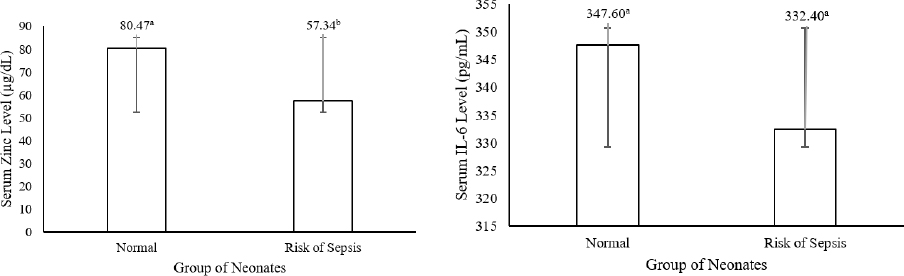
Comparison of serum zinc and IL-6 levels in normal and at-risk-of-sepsis neonates. Data presented as mean ± SD. Different lowercase letter p < 0.001 for zinc levels between groups. Different lowercase letters indicate statistically significant differences between normal and at-risk-of-sepsis neonates (p < 0.05).
Data normality for zinc and IL-6 levels was assessed using the Kolmogorov-Smirnov test, which indicated non-normal distributions (P < 0.05) for both variables. Subsequent analysis using the Mann-Whitney test revealed a statistically significant difference in serum zinc levels between the control and sepsis-risk groups (P <0.001, P < 0.05), while IL-6 levels did not differ significantly (P = 0.980, P > 0.05) (Table 2).
| Statistical Analysis | Mann-Whitney | Spearman Correlation | |
|---|---|---|---|
| p-value | p-value | Correlation Coefficient | |
| Zinc | < 0.001 | < 0.001 | - 0.548 |
| IL-6 | 0.980 | 0.792 | - 0.032 |
Spearman correlation analysis was conducted to assess the association between zinc and IL-6 levels and the risk of sepsis. A significant negative correlation was found between serum zinc levels and sepsis risk (correlation coefficient -0.548, P < 0.05), suggesting that lower zinc levels are associated with increased sepsis risk. However, IL-6 levels did not show a significant correlation with sepsis risk (correlation coefficient -0.032, P > 0.05). No significant difference in IL-6 levels was found between the sepsis-risk and healthy groups. This may be due to the inclusion of neonates at risk but not yet showing signs of sepsis, as IL-6 is a marker for early-stage infection and has a short half-life, peaking around 6 hours after bacteremia onset [35, 36]. Zinc deficiency was significantly associated with increased sepsis risk. Although this study indicates a significant negative correlation between serum zinc and IL-6 levels, IL-6 levels did not differ significantly between groups. These findings suggest that zinc may potentially not only be a risk factor but also a biomarker of neonatal sepsis. Future studies following infants over time are needed to confirm its role as an early predictive biomarker, especially when combined with inflammatory cytokines such as IL-6.
4. LIMITATIONS OF THE STUDY
This study has several limitations. First, the sample size was relatively limited and came from a single center, so generalizing the results to the general population requires caution. Second, IL-6 measurements were performed at a single sampling point, so the dynamics of changes in levels from baseline to follow-up could not be evaluated. Third, maternal infection variables were not fully assessed and may influence neonatal inflammatory markers. Furthermore, this study did not conduct a multivariate analysis to account for potential confounding factors. Therefore, additional research, conducted with a prospective, longitudinal design and a larger sample size, should be conducted to reinforce these results.
CONCLUSION
In conclusion, the average zinc levels in neonates at risk of sepsis and in healthy neonates were 57.34 ± 8.89 µg/dL and 80.47 ± 13.80 µg/dL, respectively, with a significant difference between the two groups, while IL-6 levels (332.4 ± 249 pg/mL vs. 347.6 ± 327 pg/mL) showed no significant difference. Further research with larger sample sizes and controlled variables, as well as studies on maternal zinc levels and supplementation, is recommended to better understand the role of zinc in neonatal sepsis.
AUTHORS’ CONTRIBUTIONS
The authors contributed to the manuscript as follows: P.A., N.A.P., and A.Y.: Conceived and designed the study; J.K., N.A.P., and A.A.U.: Collected the data; E.S. and I.: Performed the laboratory analyses and conducted the statistical analysis and interpretation of the results; N. A. P. and A.A.U.: Prepared the initial draft of the manuscript; E.H., S.M., P.A., and A.Y.: Critically revised the manuscript. All authors reviewed the results and approved the final version of the manuscript.
LIST OF ABBREVIATIONS
| ACOG | = American College of Obstetricians and Gynecologists |
| AUC | = Area Under the Curve |
| BCL-X | = B-cell lymphoma X (BCL-X) |
| BCL-2 | = B-cell lymphoma 2 (BCL-2) |
| CRP | = C-Reactive Protein |
| EDTA | = Ethylenediaminetetraacetic Acid |
| ELISA | = Enzyme-Linked Immunosorbent Assay |
| IFN-γ | = Interferon Gamma |
| IL-2 | = Interleukin-2 |
| IL-4 | = Interleukin-4 |
| IL-6 | = Interleukin-6 |
| IL-10 | = Interleukin-10 |
| NADPH | = Nicotinamide Adenine Dinucleotide Phosphate |
| NF-κB | = Nuclear Factor Kappa B |
| PROM | = Premature Rupture of Membranes |
| SD | = Standard Deviation |
| SDGs | = Sustainable Development Goals |
| SGA | = Small for Gestational Age |
| STAT3 | = Signal Transducer and Activator of Transcription 3 |
| Th1 | = T-helper 1 |
| Th2 | = T-helper 2 |
| TMB | = 3,3',5,5'-Tetramethylbenzidine |
| ZIP14 | = Zrt- and Irt-like Protein 14 |
| Zn | = Zinc |
ETHICS APPROVAL AND CONSENT TO PARTICIPATE
This study received approval from the Research Ethics Committee of Ulin General Hospital, Banjarmasin, South Kalimantan, Indonesia, with approval number No. 553/UN8.1.17.2/PPDS.IKA/2021.
HUMAN AND ANIMAL RIGHTS
All procedures performed in studies involving human participants were in accordance with the ethical standards of institutional and/or research committees and with the 1975 Declaration of Helsinki, as revised in 2013.
CONSENT FOR PUBLICATION
Written informed consent was obtained from the parents or guardians of every study subject.
AVAILABILITY OF DATA AND MATERIALS
All data generated or analyzed during this study are included in this published article.
FUNDING
This study was supported by the Research and Community Service Unit (LPPM) Universitas Lambung Mangkurat (ULM) through the PDWM Program 2024 (grant number 804/UN8.2/PP/2024).
ACKNOWLEDGEMENTS
Declared none.